
Collaboration | Housing | Learnings
Three Lessons from a Good Day for Housing in Anson County
Benji Flanagan, Our State, Our Homes Regional Liaison
August 19, 2026

Notes from the Building Anson convening on July 29, 2026
CDS Flowers, Harborwright, and what the data shows
Convening in Anson
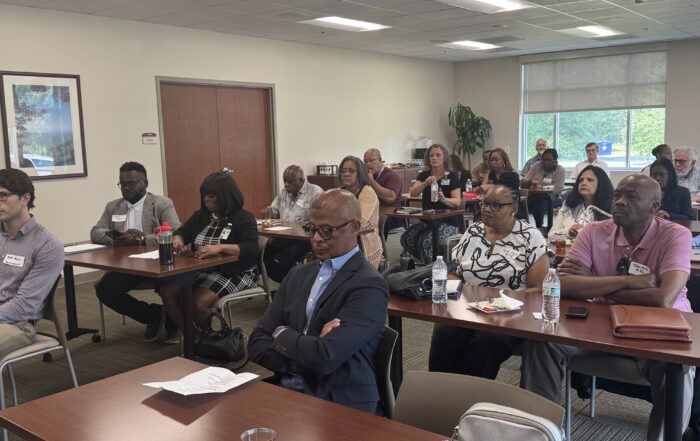
Last month, a committed group of people met together at Atrium Health in Wadesboro for a convening organized by the Building Anson Our State, Our Homes team. Local partners, leadership from the NC Dept. of Commerce, and housing data experts from the firm, Harborwright, discussed housing conditions in Anson County and what it will take to meet the county’s housing needs. This single event offers just one example of the powerful potential of cross-sector collaboration encouraged throughout the Our State, Our Homes program.
The Our State, Our Homes cohort is comprised of 14 regional teams representing 22 counties from the mountains to the coast. Building Anson is Team 7 of the cohort. Our State, Our Homes is built on the idea that local teams, with support from Carolina Across 100 – a five-year initiative at UNC Chapel Hill – and its partners, can facilitate a process that moves communities from talking about housing problems to addressing them. Since the beginning of 2025, the program has helped teams to set clear goals, bring in the right partners, and keep moving toward measurable results.
Like many teams, Building Anson has struggled with the same practical problems as other teams: everyone already has a full plate, and finding time to meet is harder than it sounds. Perhaps that is why this convening felt different. It was clear the group convened to make progress. Below, I set out three lessons for any community wrestling with housing affordability
The group convening focused on action-oriented conversation, interrogating market data, and creating local buy-in with important stakeholder groups in the same room at the same time. Bringing state leadership, independent market analysis, and county and municipal support into one conversation is the kind of vertical and step the program is designed to support and that is needed to drive local momentum.
A Return Home with Purpose: Include voices from the past
Kenny Flowers is currently Chief Deputy Secretary at the NC Dept. of Commerce. From 2017 to 2025, he ran the Rural Economic Development Division as Assistant Secretary. During his tenure, the division awarded more than $715 million in grants out the door, supporting over 2,000 projects and helping create roughly 28,000 jobs across rural North Carolina. Those are not small numbers, and they come from years of steady work on infrastructure, site readiness, building reuse, and the kinds of investments that rural communities need to compete.
What made Flowers’ presence different for this meeting is that Anson County is home for him. Having grown up in Wadesboro, he understands the place in a way that no briefing memo can inform. Having him in the room meant the local team received both the institutional insights of a senior state official and the credibility of someone who knows Anson firsthand.
Flowers was able to draw connections between Anson’s local needs and statewide programs and resources. The NC Dept. of Commerce offers ongoing rural grant programs for building reuse, infrastructure, and job creation. Local mayors in attendance were also interested in the NC Commerce Main Street Program and annual Main Street Conference. Flowers also discussed the new “First in Opportunity” plan, a comprehensive four-year economic roadmap for North Carolina released in May 2026. He noted “Housing is economic development” and referenced Goal 3 of the plan, which calls to address community well-being and workforce stability through affordable and accessible housing, childcare, and health care.
Anson by the Numbers: Data Matters
The convening also featured a presentation from Harborwright, a firm that performs market intelligence for economic development groups, public agencies, and private clients. Matt Hayes, Managing Director & Co-Founder of Harborwright offered an overview of Anson County’s housing market, including current conditions, opportunities, and recommendations. Hayes’ data helped paint a picture of the housing pressures in Anson:
- Demographic trends: Anson County is a small rural county, comprised of approximately 22,000 people, down from more than 26,000 in 2010. Households number about 8,700. Owner households outnumber renters roughly two-to-one, while seniors account for nearly 20 percent of residents. Because of low migration in and out of the county, turnover is limited, which can limit the availability of existing units for new households even in the absence of net population growth. This mix points more toward replacement demand, rehabilitation, aging-in-place needs, and modest downsizing than toward rapid new household formation and demand for major subdivisions.
- Income and poverty: Median household income is around $47,500. Per capita income is near $24,000. The poverty rate is trending at about 21 percent, and a substantial portion of households fall below 80 percent of area median income. These numbers determine who can buy or rent, on what terms, and how little room many families have for tradeoffs given limited disposable income.
- Housing supply: The county has roughly 10,000 total units. Owner-occupancy remains the majority, around 68 percent. The stock itself is heavily single-family, about 67 percent detached, with only a minor multifamily presence, about 2.6 percent. Manufactured and mobile homes make up about 25 percent of inventory, far above the national average of 5 to 6 percent. The manufactured-housing share is doing real affordability work that conventional new construction struggles to match at local wage and lot-price levels. Very little of the housing stock is new. Only about 0.5 percent of all residential units were built in 2020 or later and building permits have run only about 50 to 55 units a year recently.
- Vacancy: Year-round residential vacancy runs around 14 percent, but a high vacancy rate does not necessarily mean that housing is readily available to households seeking it. Vacant properties may be in poor condition, located away from where demand exists, held off the market, or otherwise unsuitable for current households. The challenge is not simply the number of vacant units, but whether those units can realistically become safe, affordable, and attainable housing through repair and renovation.
- Pricing: The median value of owner-occupied homes is approximately $155,000, equivalent to roughly 3.3 times median household income. Median gross rent stands near $850, a level relatively modest by statewide comparison, yet cost burdens are substantial. Approximately 43 percent of renters allocate more than 30 percent of income to housing, and roughly 26 percent are severely burdened, meaning the household spends more than 50 percent of its gross household income on housing costs. New supply into the market is very thin.
Taken together, the picture becomes clear. Modest local wages, limited new construction, rising sale prices, high-cost burden among renters, a large share of older and manufactured stock, and limited infrastructure capacity explain why workforce and affordable housing keep surfacing as a local priority. The Anson County housing production problem is not “build more.” Instead, the solution is to fix what already exists, replace existing units in poor condition, renovate the right units in the right places, preserve the affordability that manufactured housing currently provides, and help make sure working households and seniors can actually stay housed.

Barriers to Progress: Recognize and mitigate known challenges
The Building Anson convening also created opportunity to discuss the challenges that might impede progress toward meeting their housing supply needs.
For example, a major theme of the conversation was the challenge of heirs’ property. Heirs’ property is a persistent barrier to housing stability and improvement in Anson County, as it is across much of rural North Carolina. When land or a home is passed from one generation to the next without a will or formal probate, ownership often ends up fractionated among multiple heirs as tenants in common. Title remains clouded, which makes it difficult or impossible to obtain a mortgage, access rehabilitation or weatherization programs, insure the property adequately, or sell it. Families can also face forced partition sales or tax foreclosure when one heir cannot or will not cooperate. Given Anson’s focus on preservation, revitalization of aging stock, and helping lower-income and senior households stay in place, clearing or resolving heirs’ property title is often a necessary first step before any financing or improvement work can move forward. One of the practical benefits of participation in the Our State, Our Homes program has been helping teams get connected to resources to help address specific barriers to local progress.
Another challenge is that Anson sits in the path of metro Charlotte’s continued metropolitan expansion. As prices and competition intensify closer to the metropolitan core, more households and employers look further out for lower costs. That spillover can bring new demand and cost pressures. Locally, wages and incomes have not kept pace with the kinds of price increases already showing up in recent sales data. Without intentional planning, Anson risks absorbing growth that drives existing residents out of reach of ownership or stable rents, while still not delivering enough of the right product for the workers and families the local economy needs. Capturing growth opportunities without losing affordability for the citizens already there will be an important tension for Anson to manage.
Anson is not going to solve its housing needs through private market production alone but ensuring that new production can continue is also key. Water and sewer limits have blocked projects, including a proposal for four mobile-home units that was denied for lack of capacity. Targeted new construction near town centers, including smaller-scale and missing-middle forms, and deliberate use of public land or incentives need to be part of the mix. The same is true of connecting housing work to the economic development projects already moving through NC Dept. of Commerce rural programs. Building reuse, infrastructure, and job creation projects generate demand for workforce housing while also creating opportunities to layer funding to advance housing solutions.
The construction labor shortage is an impactful problem facing residential construction, especially in North Carolina. By creating and aligning a variety of workforce development strategies, community-based organizations can foster growth in construction careers, simultaneously addressing housing supply needs while promoting in-demand, good-paying jobs.
Partners who are interested in developing the construction labor workforce to support residential affordability can start by:
- Identifying where specific trade skill shortages are in the community. Once these areas are pinpointed, promote partnerships with current professionals and educational institutions like community colleges to create or expand programs that responsive to local labor market needs. By partnering with a variety of organizations, workforce developers can align themselves to specific issues while still working across scales and maximizing resources.
- Engage with young people and groups that do not traditionally work in construction, such as women. By expanding the talent pool, communities can shift the typical demographic profile of the construction industry to effectively grow the workforce.
- Secure financial and political support for existing training programs or work to establish new ones. Many community colleges or non-profits can expand their reach with additional funding. In communities where programs do not exist or existing pathways are insufficient to meet industry demand, there may be opportunities to create new workforce pathways into the construction industry.

Moving Forward
The Building Anson convening was a good day for the housing conversation in Anson County. Chief Deputy Secretary Flowers brought both state-level capacity and a personal stake in the place. Harborwright gave the group a clearer picture of current conditions, opportunities, and realistic paths forward. Local leaders put their support on the record. The underlying numbers of modest incomes, thin new supply, rising sale prices, and a large share of lower-income households explain why the work matters.
None of that solves the housing shortage by itself or guarantees that units will get built or renovated. However, all of them help formulate a plan and make the path forward a little clearer. Building Anson is now in a stronger place as it moves from planning into actual production, preservation, and policy work in the county.
The hard work continues. From identifying opportunities and securing financing and approvals to navigating pushback, Building Anson and its partners must keep working to ensure progress moves beyond discussion. But the foundations are in place and real. The question now is whether the team can turn that foundation into homes where Anson’s citizens can continue to live and thrive.
Carolina Across 100 is a five-year initiative, led by the ncIMPACT Initiative, seeking to support community-driven recovery and build sustainable efforts in all 100 counties by providing human resources, data insights, coaching, facilitation, coordination efforts, and program design. “Our State, Our Homes” is the fifth program in this larger initiative. Carolina Across 100 is funded by the Office of the Chancellor and private foundations.
The ncIMPACT Initiative coordinates Carolina Across 100. ncIMPACT is a statewide initiative launched by the UNC School of Government in 2017 to help local communities use data and evidence to improve conditions and inform decision making. Visit ncimpact.org.